
Selling a property in the UK can bring financial relief to families, whether you’re downsizing to free up funds for your children’s education or moving closer to better schools. Understanding your tax obligations prevents surprises that could derail your financial plans and helps you make informed decisions that protect your family’s resources.
Capital gains tax applies when you sell a property that isn’t your main home and make a profit above your annual allowance. For the 2026/27 tax year, this allowance stands at £3,000 per person, significantly lower than previous years. If you’re married or in a civil partnership, you can combine allowances to shelter £6,000 of gains from tax.
The good news? Your main residence typically qualifies for full relief, meaning most families selling their primary home won’t owe anything. Second properties, buy-to-let investments, and inherited homes face different rules. Tax rates range from 18% to 24% on property gains, depending on your total income and tax bracket.
Time matters when reporting and paying. You must report property sales within 60 days of completion and pay any tax due immediately, not waiting until your annual self-assessment. Missing this deadline triggers penalties that eat into proceeds you might have earmarked for family priorities.
Understanding capital gains tax on house sale scenarios helps you plan strategically. Simple steps like keeping detailed records of purchase costs, improvement expenses, and selling fees can substantially reduce your bill. Taking control of this financial aspect means less stress about money and more energy for building healthy habits with your children and helping them reduce stress during family transitions.

What is Capital Gains Tax on Property Sales?
Capital Gains Tax is a levy on the profit you make when you sell something that has increased in value. When it comes to property, this tax applies to the difference between what you originally paid for a property (including purchase costs) and what you sell it for, minus any allowable expenses.
For most families, the good news is straightforward: you don’t pay CGT when you sell your main home. The property where you and your children actually live, sleep, and build your family memories is generally exempt through what’s called Private Residence Relief. This protection recognizes that your family home isn’t an investment asset but the foundation of your daily life.
However, CGT becomes relevant in several scenarios that many parents and teachers encounter. If you own a second property, perhaps a buy-to-let flat you’re renting out to supplement your income, you’ll typically owe CGT on any profit when you sell. The same applies to properties you’ve inherited from parents or relatives but don’t live in as your main residence. Even if you’ve used part of your home exclusively for business purposes, that portion might not qualify for the full exemption.
- Capital Gain
- The profit you make when selling a property for more than you paid for it, calculated after deducting purchase costs and allowable expenses.
- Disposal
- The tax term for selling, gifting, or transferring ownership of a property to someone else.
- Chargeable Gain
- The amount of profit subject to tax after you’ve subtracted all allowable deductions and applied any relevant reliefs or exemptions.
- Principal Private Residence
- Your main family home where you live most of the time, which usually qualifies for full CGT exemption when sold.
The trigger for CGT is what tax authorities call a “disposal,” which happens when you sell a property, give it away, transfer it to someone else, or even exchange it for something of value. What matters is whether you’ve made a gain and whether that gain qualifies for any exemptions. Understanding this distinction helps you plan property decisions around your family’s financial future and avoid unexpected tax bills.
When Does CGT Apply to Your Property Sale?
When you sell property in the UK, whether you owe capital gains tax depends entirely on what type of property you’re selling and how you’ve used it. The good news? Your family home is usually protected.
If you’re selling the house where you and your children actually live as your main residence, you won’t pay CGT thanks to principal private residence relief. This exemption exists to protect families from being taxed on the roof over their heads. However, complications arise when properties serve multiple purposes or you own more than one.
**Buy-to-let properties** always trigger CGT when you sell at a profit. Perhaps you bought an investment property years ago to generate rental income for your children’s future university fees. When you sell, any gain above your annual exemption becomes taxable. Many parents discover this the hard way when downsizing their property portfolio to fund education costs.
**Inherited family homes** present a different scenario. If you inherit your parents’ house and sell it relatively quickly, you may owe little or nothing because the gain is calculated from the property’s value at the date of death, not the original purchase price. But if you keep an inherited property for years, watch it appreciate, then sell, you’ll likely face CGT on that growth. Some families choose to move into an inherited home and make it their main residence before selling to claim the relief.
**Second homes and holiday cottages** are taxable when sold, even if your family uses them regularly. That seaside cottage where you spend summer holidays with the kids counts as a second property, not your main home.
Properties used partially for business create particularly tricky situations for teachers who run tutoring services from home or parents with home offices. If you’ve claimed tax relief for using part of your home exclusively for business, that portion may not qualify for full principal private residence relief when you sell.
The key question is always: was this your main home throughout your ownership? If not, expect CGT to apply to at least part of any gain.

Understanding CGT Rates in 2026
Property sales attract different capital gains tax rates than other assets, a distinction that can mean thousands of pounds difference to your final bill. Here’s what families selling property in 2026 need to know about the numbers that will affect your finances.
If you’re a basic rate taxpayer, you’ll pay 18% on any gains from residential property sales. Higher and additional rate taxpayers face a steeper 24% rate. This is where property CGT stands apart from other investments: shares, for instance, are taxed at 10% and 20% respectively. The government applies higher rates to property gains specifically, reflecting both the typically larger sums involved and policy goals around housing.
Your tax band is determined by your total income for the year, including the gain itself. This matters because a property sale can push you from the basic rate into the higher rate threshold, meaning part of your gain gets taxed at 18% and the remainder at 24%. It’s not an all-or-nothing calculation.
| Taxpayer Category | CGT Rate on Property | CGT Rate on Other Assets |
|---|---|---|
| Basic Rate | 18% | 10% |
| Higher/Additional Rate | 24% | 20% |
Before any tax is due, you can use your annual exempt amount essentially a tax-free allowance on capital gains. For 2026, this stands at £3,000 per person. Married couples and civil partners can each use their own allowance, potentially sheltering £6,000 of gains from tax altogether. This is down significantly from previous years, so don’t assume old figures still apply.
The official CGT rates and allowances are updated annually, and it’s worth checking before you finalize any sale. Small changes can have large impacts when you’re dealing with property values that affect your children’s school fees or family security.
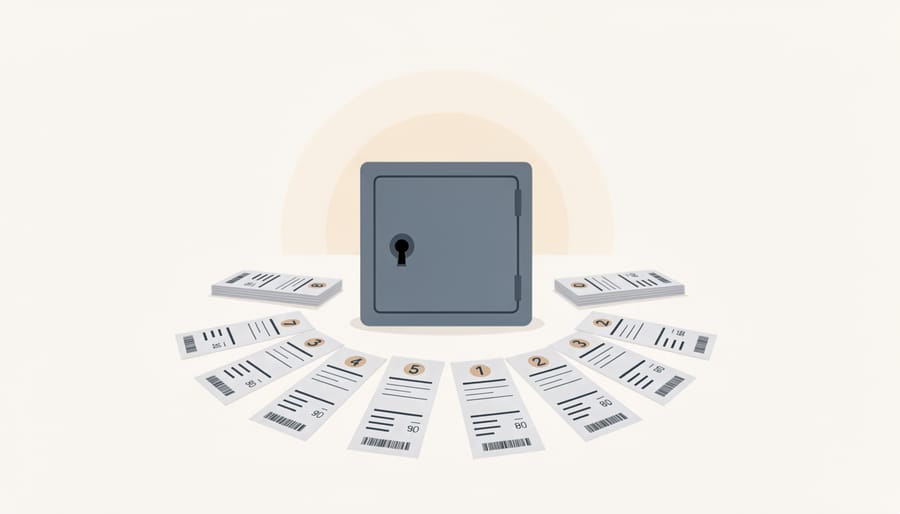
How to Calculate Your Capital Gains Tax
Calculating your capital gains tax might seem daunting, but breaking it down into clear steps makes it manageable. Here’s how to work out what you’ll owe.
**Start with the basics: your gain**
First, subtract what you originally paid for the property from what you sold it for. If you bought a rental flat for £180,000 and sold it for £260,000, your initial gain is £80,000. But you’re not taxed on that full amount, several deductions can reduce it significantly.
**Deduct your allowable costs**
You can subtract the costs directly tied to buying and selling the property. When you purchased, did you pay solicitor fees, stamp duty, or surveyor costs? These count. Add up any estate agent fees, solicitor fees, and advertising costs from the sale too. If these totalled £15,000 in our example, your gain drops to £65,000.
Improvement costs also reduce your taxable gain, but there’s a crucial distinction: you can claim for extensions, loft conversions, or new kitchens that added lasting value. Regular maintenance like repainting, fixing a boiler, or replacing worn carpets doesn’t qualify. If you spent £20,000 on a proper extension, that brings the gain down to £45,000.
**Apply your annual exemption**
For the 2026-27 tax year, the annual CGT exemption is £3,000 per person. This amount comes off your gain before you calculate any tax. In our example, £45,000 minus £3,000 leaves £42,000 as your taxable gain.
If you own the property jointly with your spouse or civil partner, you each get the £3,000 exemption. That property sold for £260,000? If owned jointly, you’d each have a £22,500 gain (half of £45,000), then each subtract £3,000, leaving £19,500 taxable per person.
**Calculate the tax**
Apply the appropriate rate to your taxable gain. Basic rate taxpayers pay 18% on property gains; higher and additional rate taxpayers pay 24%. Your tax band depends on your total income plus the gain, so if adding the property gain pushes you into the higher rate bracket, you might pay 18% on part of the gain and 24% on the remainder.
Using our £42,000 taxable gain example: if you’re a higher rate taxpayer, multiply £42,000 by 24%, which equals £10,080 in CGT.
Keep all receipts and records of every cost you’re claiming. HMRC may ask for evidence, and missing documentation could mean paying more tax than necessary.
Legitimate Ways to Reduce Your CGT Bill
Nobody wants to pay more tax than necessary, especially when every pound saved could support your children’s activities, education, or family security. The good news is that UK tax law offers several legitimate ways to reduce your CGT liability when selling property, and understanding these strategies can make a substantial difference to your final bill.
**Use Your Annual Exemption Wisely**
Every UK taxpayer gets an annual CGT exemption (£3,000 for the 2025/26 tax year). This means the first £3,000 of gains you make in any tax year is completely tax-free. If you’re planning a property sale that will generate significant gains, consider the timing carefully. Splitting a sale across two tax years or coordinating with other asset sales can help you maximize this exemption. Remember, it’s a “use it or lose it” allowance that doesn’t carry forward.
**Transfer Assets Between Spouses**
Married couples and civil partners can transfer property between themselves without triggering CGT. This creates a valuable planning opportunity. If one spouse is a basic rate taxpayer and the other pays higher rate tax, transferring ownership before selling can result in the gain being taxed at 18% instead of 24%. Both spouses can also use their individual annual exemptions, potentially sheltering £6,000 of gains from tax entirely. This strategy requires forward planning, as the transfer should happen well before the sale.
**Claim Every Allowable Expense**
Many families miss out on legitimate deductions simply because they don’t realize what qualifies. You can deduct the original purchase price, estate agent and solicitor fees from both buying and selling, stamp duty you paid when buying, and costs of improvements (not repairs) you made to the property. Even advertising costs and valuations can be claimed.
**Maximize Principal Private Residence Relief**
If you’ve lived in the property as your main home for any period, you may qualify for partial relief. The final nine months of ownership always count as your main residence for CGT purposes, even if you’ve already moved out. If you lived in a property before renting it out, or moved back in before selling, these periods reduce your taxable gain proportionately. For families who’ve inherited a property and lived in it temporarily, this relief can be particularly valuable.
**Time Your Sale Strategically**
The timing of your property sale can significantly impact your tax bill. If you’re having a lower-income year (perhaps due to parental leave, sabbatical, or reduced hours), selling during this period could keep you in the basic rate tax band. Similarly, if you’re approaching retirement and expect your income to drop, delaying a sale might be worthwhile. Just balance tax savings against market conditions and your family’s immediate financial needs.
Reporting and Paying Your CGT
Selling a property triggers specific reporting and payment deadlines that you need to meet, regardless of whether you’re a parent selling an investment property to fund your child’s education or a teacher disposing of an inherited home. Getting these timings right matters because missing them can lead to penalties that eat into the money you’re setting aside for your family’s needs.
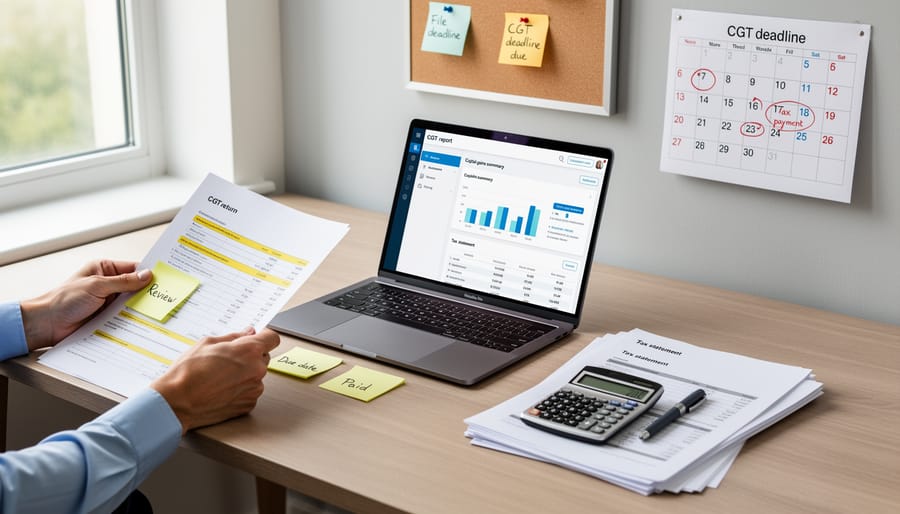
You must report your property sale to HMRC within 60 days of completion. This deadline applies even if you don’t owe any tax because your gain falls below the annual exemption or you’re claiming principal private residence relief. The 60-day window starts when you complete the sale, not when you exchange contracts, and there are very few exceptions to this rule.
To report the sale, use the HMRC CGT property reporting service, which you access through your Government Gateway account. The online service walks you through the process: you’ll enter details about the property, the sale price, your allowable costs, and the tax calculation. The system then generates a payment reference and tells you exactly how much CGT you owe, if any. If you don’t have a Government Gateway account, set one up before your deadline approaches, this can take time.
Payment is also due within 60 days of completion. You can pay online via bank transfer, debit card, or through your bank’s telephone or branch services using the payment reference HMRC provides. Some parents find that careful financial organization, similar to the approach you might take with meal planning for your family’s weekly routine, helps ensure you’ve set aside the necessary funds by the payment date.
If you miss the 60-day deadline, HMRC charges interest on unpaid tax from day 61, currently at 6.5% per year. Late filing also triggers penalties: an initial £100 fine, followed by daily penalties of £10 after three months, then further percentage-based charges after six and twelve months. These penalties stack up quickly and can significantly reduce the funds you’ve earmarked for your children’s future.
Common Questions Parents Ask About Property CGT
When families start thinking about selling property, questions multiply, especially when children’s futures and family finances intersect. Here are the CGT concerns that come up most often in parent and educator circles.
**Can I avoid CGT if I’m selling property I inherited from my parents?**
Inheritance itself doesn’t trigger CGT. Your “acquisition cost” for CGT purposes is the property’s market value when you inherited it, not what your parents originally paid. You’ll only owe CGT on any gain from that inheritance date to when you sell. If you moved into the inherited property and made it your primary home before selling, you might qualify for principal private residence relief on part or all of the gain, depending on how long you lived there.
**What if I’m selling a property specifically to fund my children’s education?**
Your reason for selling doesn’t affect your CGT liability, the tax rules apply the same whether you’re funding college applications or buying a boat. However, timing can help. If you’re planning a sale for school fees, consider whether spreading the sale across two tax years (if practical) might let you use two annual exemptions. Some parents also explore whether transferring partial ownership to a spouse in a lower tax bracket before selling could reduce the overall family tax bill.
Do properties held in family trusts have different CGT rules?
Yes, trusts face their own CGT rates and smaller annual exemptions than individuals. Trustees may also face CGT when transferring property out of a trust to beneficiaries, making professional advice essential for family trust situations.
What happens to CGT on jointly owned property during divorce?
Transfers between spouses during marriage or in the tax year of separation are usually CGT-free. After that separation tax year, transfers may trigger CGT, so timing matters significantly in divorce property settlements.
Can I add my children’s names to property ownership to reduce CGT later?
Adding children as joint owners is treated as a partial disposal for CGT purposes, potentially triggering an immediate tax charge. This strategy rarely saves money and can create complications with future sales and inheritance tax.
**If my child lives in a property I own, does that change my CGT position?**
Simply having your adult child live in your rental property doesn’t qualify you for principal private residence relief, it must be your own home. The property remains an investment for CGT purposes. However, if you genuinely share the property as your primary residence together, different rules might apply, though proving this to HMRC requires solid evidence of it being your main home too.
These family scenarios show why property CGT planning deserves the same careful thought you’d give to decisions about kids’ water quality or school choices, the financial impact on your family’s resources can be substantial and long-lasting.
When to Seek Professional Advice
Certain property sale situations are straightforward enough to handle yourself, but others can quickly become complicated. If you’re dealing with multiple properties, inherited homes with unclear purchase costs, or properties you’ve used both personally and for business, professional tax advice often pays for itself many times over.
You should seriously consider expert help if you’ve owned the property for decades and the gain is substantial, if you’re selling shortly after inheriting (when valuation timing matters), or if you’ve lived abroad during ownership. Properties held in trust, sales involving non-UK residents, or situations where you’ve claimed business reliefs all warrant professional guidance.
When choosing a tax advisor, look for someone who’s a chartered tax adviser (CTA) or chartered accountant (CA) with specific experience in property taxation. Ask about their familiarity with family situations like yours. A good advisor won’t just calculate your bill, they’ll explore legitimate ways to reduce it through timing strategies, spousal transfers, or reliefs you might not know exist.
The cost typically ranges from £500 to £2,000 depending on complexity, but this investment can save you thousands in avoided tax and penalties. Think of it as protecting your family’s resources. Many parents find that a single consultation before selling helps them structure the transaction far more tax-efficiently, freeing up more money for their children’s education, home improvements, or emergency funds.
Understanding how capital gains tax affects your property sales is not just about ticking boxes on a tax return. It’s about protecting the resources you have worked hard to build for your family’s future.
Every pound you save through careful CGT planning is a pound that can go toward your children’s education, their extracurricular activities, family holidays that create lasting memories, or simply the financial security that lets you sleep better at night. For teachers considering property investments to supplement retirement income, smart tax planning means more resources to enjoy the years ahead without financial stress.
The good news is that CGT on property sales is manageable when you understand the rules and plan ahead. Whether you are selling an inherited property, downsizing, or disposing of an investment that no longer fits your family’s needs, taking time to understand your obligations and opportunities makes a real difference to your bottom line.
Start by reviewing your property situation now, not when you are already committed to a sale. Keep good records of all property-related expenses. Consider the timing of sales in relation to your income and tax position. And do not hesitate to seek professional advice when your circumstances are complex.
The knowledge you have gained here empowers you to make informed choices that serve your family’s best interests. With proper planning, you can navigate property sales confidently, knowing you are both meeting your legal obligations and preserving as much as possible for what truly matters: your children’s wellbeing, education, and future opportunities.